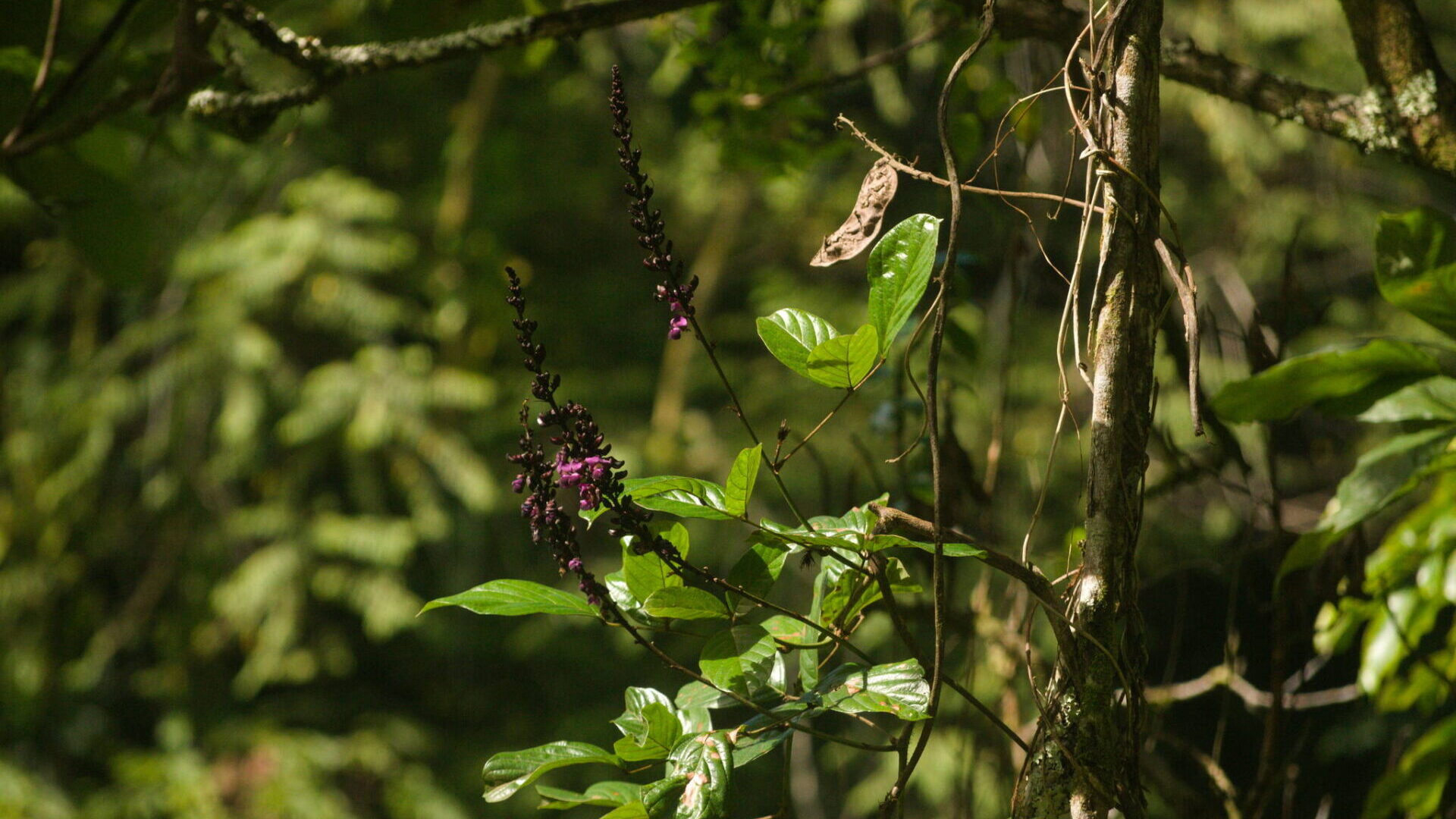
📷 (c) Kevin Faccenda, some rights reserved (CC BY) (cc-by)
Wilson’s Clusterpea
Macropsychanthus wilsonii
Classification
| Kingdom | Plantae |
|---|---|
| Phylum | Tracheophyta |
| Class | Magnoliopsida |
| Order | Fabales |
| Family | Fabaceae |
| Genus | Macropsychanthus |
| Species | Macropsychanthus wilsonii |
At a Glance
Key metrics will appear once data is available.
Macropsychanthus wilsonii, commonly known as Wilson’s Clusterpea, is a legume distributed across the tropical Americas, with established populations in Hawaii, Madagascar, and French Polynesia. The species occurs in at least 16 countries, spanning from Mexico and Central America through the Caribbean and into South America, with the highest concentration of records in Brazil. iNaturalist data indicates over 900 occurrences documented globally, reflecting its presence across diverse tropical and subtropical regions.
This member of the Fabaceae family inhabits lowland tropical forests, coastal areas, and disturbed habitats where it has naturalized beyond its native range. The species shows a remarkable ability to establish in varied environmental conditions, from humid tropical forests to more seasonal dry zones. Its wide geographic distribution suggests ecological flexibility and successful adaptation to multiple climatic zones.
Identification and Appearance
Macropsychanthus wilsonii is a woody vine or scrambling shrub characteristic of tropical legumes. The plant produces compound leaves typical of the genus, with leaflets arranged in a pinnate pattern. The species bears distinctive purple or violet flowers arranged in clustered inflorescences, giving rise to its common name.
Flowers are followed by elongated seed pods containing multiple seeds. The plant’s climbing or spreading growth habit allows it to reach considerable heights when supported by surrounding vegetation. Stems are woody and persistent, enabling the species to form substantial woody structures in established populations.
Growth and Development
Little is documented about the specific growth rate and developmental timeline of Macropsychanthus wilsonii. As a woody perennial legume, the species likely exhibits typical growth patterns for tropical climbing or scrambling shrubs, establishing quickly in suitable conditions and developing woody stems over multiple growing seasons.
The species appears to be evergreen or semi-evergreen in tropical regions, maintaining foliage year-round in humid climates. In more seasonal environments, growth may slow during dry periods, though the species’ presence in diverse climatic zones suggests considerable phenological flexibility.
Distribution and Habitat
iNaturalist data indicates Macropsychanthus wilsonii occurs across a vast geographic range spanning Central America, South America, the Caribbean, Hawaii, and Indo-Pacific islands. The species is documented from Mexico south through Guatemala, Belize, Honduras, Nicaragua, Costa Rica, and Panama. In South America, it occurs throughout much of Brazil, as well as in French Guiana, Suriname, and Guyana. Additional populations are established in Madagascar and French Polynesia.
The species inhabits lowland tropical forests, forest margins, and disturbed areas where it has naturalized successfully. It grows in humid tropical climates with high rainfall and warm year-round temperatures. The documented occurrences at elevations and latitudes ranging from sea level to moderate elevations suggest adaptation to varied topography and soil conditions throughout its range.
Flowering and Reproduction
Flowering patterns in Macropsychanthus wilsonii appear to occur seasonally, with recent observations documented from January through November, suggesting extended or multiple flowering periods throughout the year in tropical regions. The clustered purple flowers attract pollinators typical of tropical legumes, including insects and potentially birds.
Reproduction occurs through seed dispersal from elongated seed pods. The species produces viable seeds capable of germination in suitable conditions, enabling both natural spread and human-mediated introduction to new regions. Propagation from seed appears to be the primary reproductive method, with the species establishing readily in disturbed habitats and open areas.
Uses and Cultivation
Little is documented about traditional or economic uses of Macropsychanthus wilsonii. The species’ presence in cultivation in Hawaii and other regions outside its native range suggests ornamental value based on its attractive purple flowers and climbing growth habit. Its establishment in disturbed areas and ability to naturalize successfully indicates potential utility in restoration contexts or as a pioneer species in secondary vegetation.
The species is cultivated in botanical collections and gardens in Hawaii and other tropical regions, where it grows readily in warm climates. Its vigorous growth and prolific flowering make it suitable for tropical landscaping, particularly where climbing or screening vegetation is desired.
Conservation
No formal conservation status has been assigned to Macropsychanthus wilsonii. The species’ wide geographic distribution, large number of documented occurrences, and successful establishment across multiple continents suggest it is not currently threatened with extinction. Its ability to naturalize and persist in disturbed habitats indicates considerable ecological resilience.
The species’ expanding range through human-mediated introductions demonstrates its capacity to establish in new regions and maintain populations without active conservation intervention. Current population trends are unknown, but the frequency of recent observations and continued documentation of new occurrences suggest stable or increasing populations across much of its range.
Fun Facts
- iNaturalist data indicates over 900 documented occurrences of Macropsychanthus wilsonii globally, making it one of the well-recorded tropical legumes.
- The species has successfully naturalized in Hawaii, where it is frequently observed in lowland forests and disturbed areas on the Big Island and Oahu.
- Macropsychanthus wilsonii occurs naturally across at least 16 countries, spanning three continents and multiple ocean islands.
- Recent observations from 2026 document the species in French Guiana, Costa Rica, Hawaii, and Belize, confirming its continued presence and active distribution across its range.
- The species’ purple clustered flowers give rise to its common name, Wilson’s Clusterpea, distinguishing it visually from related Fabaceae species.
- Its establishment in Madagascar and French Polynesia represents significant range expansion beyond the Americas, demonstrating successful long-distance dispersal or human introduction.
- The species appears in botanical collections and gardens throughout tropical regions, valued for its attractive flowering and vigorous growth habit.
Ecology and Characteristics
Growth Habit
Water Needs