Fungi
Amanita muscaria
| Kingdom | Fungi |
|---|---|
| Phylum | Basidiomycota |
| Class | Agaricomycetes |
| Order | Agaricales |
| Family | Amanitaceae |
| Genus | Amanita |
| Species | Amanita muscaria |
Key metrics will appear once data is available.
Amanita muscaria, the fly agaric, is a basidiomycete fungus that plays a crucial role in forest ecosystems across the Northern Hemisphere and beyond. This iconic mushroom forms ectomycorrhizal partnerships with trees, extending their root systems and facilitating the exchange of nutrients and carbohydrates between fungus and host. As an ectomycorrhizal fungus, A. muscaria does not decompose dead wood but instead lives in mutualistic symbiosis with living tree roots, where it enhances water and nutrient absorption for its plant partners while receiving photosynthetically derived sugars in return.
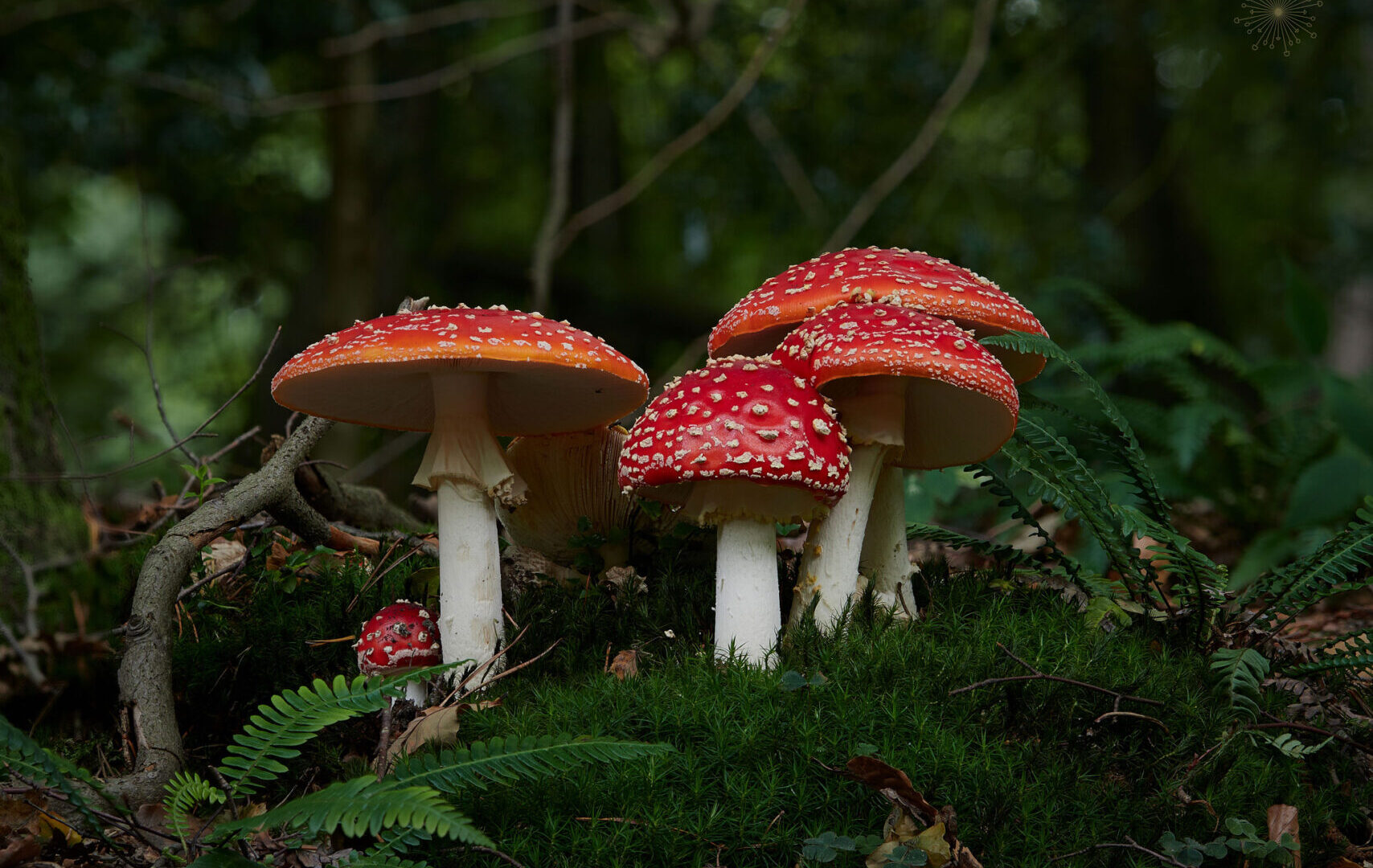
The fly agaric is arguably the most recognizable fungus in the world, instantly identifiable by its scarlet cap dotted with white warts. This distinctive appearance has cemented its place in human culture, from medieval folk traditions to modern video games and children’s literature. Its widespread distribution across temperate and boreal regions, combined with its striking morphology, makes it a subject of fascination for mycologists, ecologists, and the general public alike.
The bright red cap ranges from 5–30 centimetres (2–12 inches) in diameter. The cap changes from globose to hemispherical and finally to plate-like in mature specimens. After emerging from the ground, the cap has an irregular distribution small white to yellow pyramid-shaped warts. These are remnants of the universal veil, a membrane that encloses the entire mushroom when it is still very young. Age and rain may cause the red colour to fade and the warts to fall off.
The free gills are white, as is the spore print. The stem is 7–20 cm tall and 1.5–4 cm wide, tapering towards the top, with an expanded or bulbous base, white in colour. A large, well-developed ring connects the young cap’s margin to the stem. As the cap expands, the ring is released from the cap’s margin and hangs like a skirt from the stem, smooth on its upper side and often with a thick cream to yellowish edge. The cup is thick and leaves broken horizontal or diagonal bands and ridges of loose, cottony, white to yellowish-cream material on the lower stem.
The complex genetic diversity of A. muscaria suggests that it is a species complex. Color variants occur across its range; some populations have yellow or orange caps rather than the classic bright red. The several colour forms of the fly agaric had been named formally as varieties but molecular data unfortunately did not support neat classification by colour characteristics. Instead, our western North American fly agarics represent at least three different species that do not correlate to colour forms or the named varieties.
Fly agaric fruiting bodies emerge from the soil looking like white eggs. After emerging from the ground, the cap has an irregular distribution small white to yellow pyramid-shaped warts. These are remnants of the universal veil, a membrane that encloses the entire mushroom when it is still very young. Dissecting the mushroom at this stage reveals a characteristic yellowish layer of skin under the veil, which helps identification. As the fungus grows, the red colour appears through the broken veil and the warts become less prominent; they do not change in size, but are reduced relative to the expanding skin area.
Fly agarics grow from the ground near both conifers and broadleaved trees and may be common and widespread in the late summer and autumn. Amanita muscaria is an ectomycorrhizal fungus, meaning it forms a partnership with the roots of living trees. It does not grow on dead wood or in open fields. Its primary partners are birch, pine, spruce, and fir, though it also associates with oak and other hardwoods.
It is a widely distributed mushroom native to temperate and boreal forests of the Northern Hemisphere, now also naturalised in the Southern Hemisphere, forming symbiotic relationships with various trees and spreading invasively in some regions. iNaturalist data indicates over 315,000 occurrences documented globally, with observations spanning North America, Europe, Australia, New Zealand, and South America. The species has been unintentionally introduced to many regions through the planting of birch and pine plantations.
In the Southern Hemisphere, introduced populations have been documented forming partnerships with native beech species in Australia and New Zealand. The fungus has been introduced to Australia and New Zealand, where it spreads in association with local Nothofagus and is a species of increasing concern to foresters. The species thrives in forests with well-drained soils and cool, moist conditions typical of temperate and boreal regions.
The fungus grows in mutualistic symbiosis with trees and function as extensions of plants’ root systems forming ectomycorrhizae. Mycorrhizal fungi live in the roots of host plants, where they exchange sugars that plants produce by photosynthesis for mineral nutrients that fungi absorb from the soil. This partnership increases the absorptive surface area of tree roots, allowing plants to access water and nutrients more efficiently than they could alone.
In symbiosis, fungi contribute to tree nutrition by means of mineral weathering and mobilization of nutrients from organic matter, and obtain plant-derived carbohydrates as a response. Recent studies indicate that mycorrhizal fungi also play a significant role in belowground carbon sequestration, which may mitigate the effects of anthropogenic CO2 emissions. The ecological importance of A. muscaria extends beyond individual tree nutrition; it influences forest biogeochemistry and helps maintain ecosystem health and resilience.
Ingestion of the mushroom can cause poisoning, especially in children and those seeking its hallucinogenic effects, due to psychoactive compounds like muscimol and ibotenic acid; however, fatal poisonings are extremely rare. The fly agaric is toxic and should never be consumed. Symptoms of poisoning include nausea, vomiting, dizziness, and in severe cases, delirium and seizures.
It was traditionally used as an insecticide. The cap was broken up and sprinkled into saucers of milk. It’s known to contain ibotenic acid, which both attracts and kills flies – which gave it its name. This historical use as a fly poison is the origin of both its common name and scientific epithet (muscaria from Latin musca, meaning “fly”). One compound isolated from the fungus is 1,3-diolein (1,3-di(cis-9-octadecenoyl)glycerol), which attracts insects. It has been hypothesised that the flies intentionally seek out the fly agaric for its intoxicating properties.
No formal conservation status has been assigned to Amanita muscaria, as the species is widespread and abundant across much of its native range. The fungus is not currently considered threatened or endangered. However, in regions where it has been introduced, such as Australia and New Zealand, it is regarded as an invasive species of concern due to its rapid spread and potential ecological impacts on native forest communities.
The fly agaric’s ability to form mycorrhizal associations with a broad range of tree species facilitates its establishment in new environments. While this adaptability ensures its persistence, it also raises questions about its long-term ecological effects in invaded ecosystems, particularly regarding competition with native mycorrhizal fungi and impacts on forest composition.
It was common on Christmas cards in Victorian and Edwardian times as a symbol of good luck and its colours are thought to have been the inspiration for Santa Claus’s red and white suit.
Its name may come from its historical use to kill flies or from the effects it causes (a medieval belief held that flies could enter the head and cause madness).
The charismatic Fly Agaric, Amanita muscaria, may be the most widely recognized fungus in the world; drawings of its mushroom are featured in Tintin books, fairy tales, and video games.
Unlike most ectomycorrhizal species, A. muscaria can be cultured and its symbiosis synthesized in vitro. For this reason, it was an early target of research focused on the molecular underpinnings of ectomycorrhizal symbioses and a large body of literature describes the genetics and transcriptomics of the species.
Amanita muscaria is the type species of the genus. By extension, it is also the type species of Amanita subgenus Amanita, as well as section Amanita within this subgenus.
The fly agaric’s psychoactive properties have been documented in ethnobotanical literature, though modern research on potential therapeutic applications remains in early stages.
Native throughout the temperate and boreal regions of the Northern Hemisphere, Amanita muscaria has been unintentionally introduced to many countries in the Southern Hemisphere, generally as a symbiont with pine and birch plantations, and is now a true cosmopolitan species.