
Fungi
When spring arrives in the forests of northeastern North America, the woodland mosquito emerges from overwintering eggs to become one of the season’s most persistent biters. Aedes stimulans (Walker, 1848), commonly known as the woodland mosquito, is a medium-sized mosquito species that thrives in the cool, shaded environments of early spring. Found from Newfoundland south to Maryland and west to eastern Kansas, this species is particularly abundant in forested regions where temporary pools and wetlands provide ideal breeding grounds. Its aggressive biting behavior and longevity make it a significant pest throughout its range, especially in areas where housing developments encroach upon its woodland habitat.
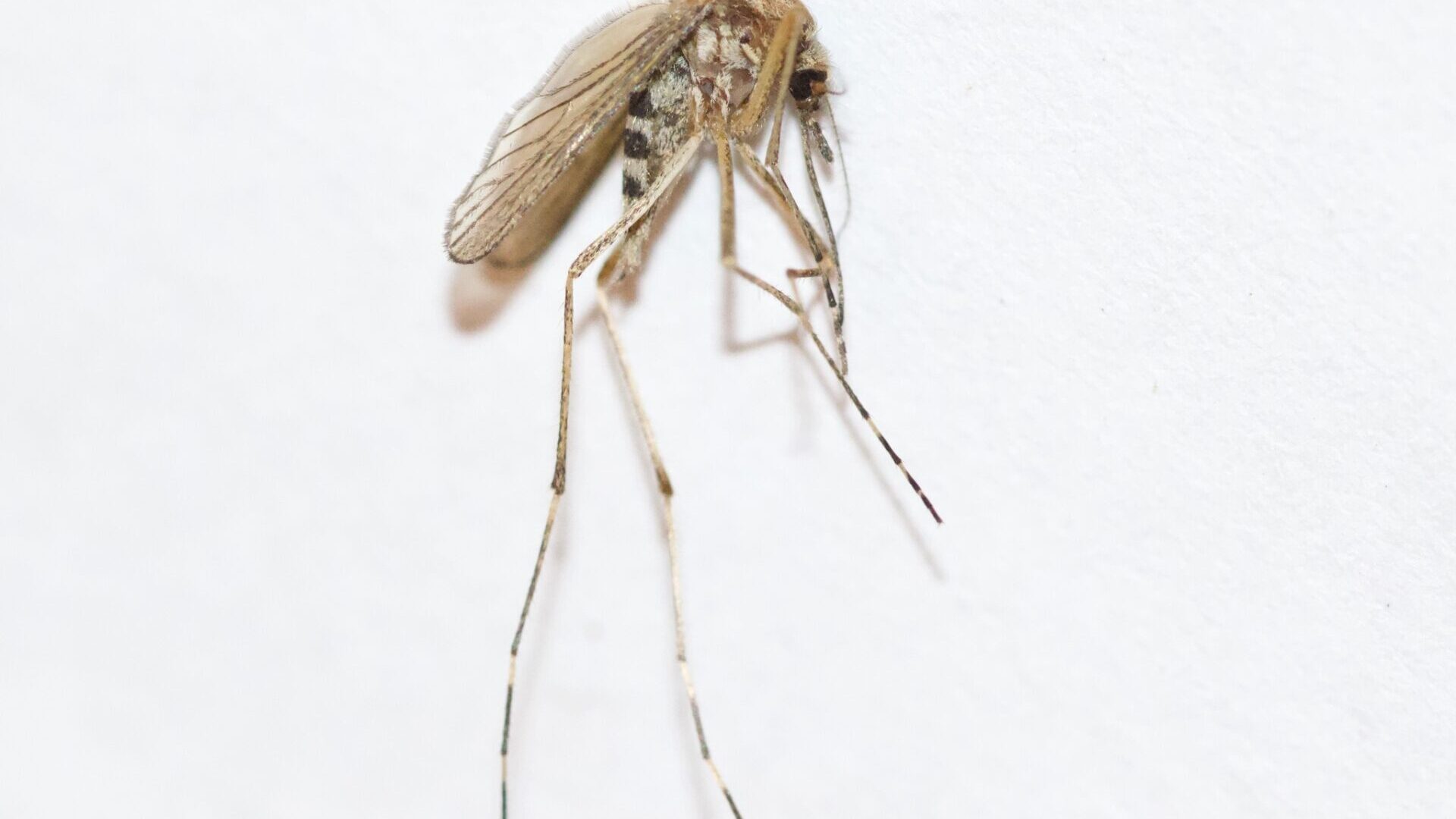
Aedes stimulans adults are medium-sized mosquitoes with distinct features. The proboscis is dark-scaled, and the palpi are short with white-tipped scales. The thorax is covered in dark brown to black scales, and the abdomen displays narrow white bands on each segment. The legs are dark with pale bands at the joints, typical of many Aedes species. These pale bands at the leg joints serve as a reliable field mark for identification, distinguishing this species from other early-season mosquitoes that may share its habitat.
Larval identification requires closer examination. Larvae are characterized by head hairs: the upper head hair is usually double (occasionally single), and the lower head hair is single. The siphon has an index of 3.0–3.5, and the saddle is incomplete with spicules along the posterior edge, distinguishing it from similar species like Aedes communis. Under magnification, the larval siphon and saddle structure provide the most reliable diagnostic features, though the double upper head hair is a useful quick reference in the field.
Female Aedes stimulans are aggressive biters, targeting humans and animals in wooded areas. Unlike many mosquito species that show preference for particular hosts or times of day, this species exhibits opportunistic feeding behavior. The mosquito bites avidly in the woodlands close to its larval habitat but will also enter communities in numbers in quest of a blood meal. This willingness to venture beyond forest boundaries into residential areas makes it a particularly troublesome pest in suburban developments.
Aedes stimulans is exceptionally long lived and can be collected in light traps into the month of August. This extended adult lifespan—unusual for a species that emerges so early in spring—allows individual females multiple opportunities to locate hosts and lay eggs over several months. The species is active during daylight hours, with peak biting activity occurring in shaded areas where light is filtered through the forest canopy.
Aedes stimulans is a univoltine Aedes of the northeastern United States and southern boundaries of eastern Canada. Its range extends from Newfoundland south to Maryland, west to eastern Kansas and north to the upper Great Lakes region. Within this broad range, the species shows interesting variation in abundance. Aedes stimulans is widely distributed in New Jersey but is most common in the northern third of the State. Scattered populations have been reported from most of the southern counties but the species cannot be considered common in any area of the Pine Barrens.
The species’ distribution closely follows the availability of suitable woodland breeding habitat. It is primarily found in the northeastern United States and eastern Canada, thriving in shaded woodland environments. Elevation influences phenology significantly—populations at higher elevations develop more slowly than those in warmer southern areas, creating a staggered emergence pattern across the species’ range.
Both adult and larval Aedes stimulans have distinct nutritional strategies. Adult females require blood meals to produce eggs, making them obligate blood-feeders. Males and females both feed on nectar and plant sugars when blood is unavailable, though only females pursue vertebrate hosts. The larvae are filter-feeders, consuming algae, organic detritus, and microorganisms suspended in their aquatic habitat. In the leaf-litter-rich pools where they develop, larvae have abundant food sources from decomposing plant material that colors the water dark brown or black.
Females require blood meals to lay eggs, which enter diapause until the next spring. This reproductive strategy is critical to the species’ survival—eggs must enter a dormant state to survive the summer drought and winter cold, hatching only when spring flooding reactivates them. A single blood meal can enable a female to produce multiple batches of eggs over her lifetime, maximizing reproductive output during the limited spring season.
Aedes stimulans is univoltine, producing one generation annually. This single-generation-per-year strategy is tightly synchronized with the seasonal availability of suitable breeding habitat. Hatching occurs in early spring, with larvae developing in cold water. Pupation takes place in late April at higher elevations or earlier in southern areas, and adults emerge by May.
Aedes stimulans females seek a host during the month of May. The pools that produced the single generation dry down quickly as the surrounding trees leaf out and females lay a band of eggs around the perimeter. This egg-laying behavior is distinctive—rather than depositing eggs directly in water, females carefully position them on moist soil and debris at the pool’s edge, just above the waterline. This placement strategy ensures eggs remain in contact with moisture while avoiding complete submersion. Eggs are laid on moist substrates above the waterline, capable of withstanding desiccation. Once laid, eggs enter diapause and remain dormant through summer and fall, waiting for the temperature and moisture cues of the following spring to trigger hatching.
No formal conservation status has been assigned to Aedes stimulans by the IUCN, as it is not considered threatened or endangered. The species remains common throughout much of its range, with populations stable or increasing in some areas. However, the species presents a significant public health and quality-of-life concern rather than a conservation concern.
Aedes stimulans is recognized as one of northern New Jersey’s most important early season pests. Housing developments that are built in wooded settings have severe problems if the woodlands harbor breeding habitat for this species. The primary threat to human interests comes from the species’ abundance and aggressive biting behavior, not from any threat to the species itself. Aedes stimulans is a probable vector of dog heartworm (Dirofilaria immitis) in regions like northern New Jersey, due to its longevity and biting habits. It poses a veterinary health concern for dogs but is not a primary vector for human diseases like dengue or Zika. This veterinary significance makes management of the species important in areas where dogs are exposed to outdoor environments during the mosquito season.
This is one of the first mosquitoes to appear in northern New Jersey, preceded only by Aedes communis and Aedes provocans.
Aedes stimulans has an affinity for shaded woodland pools with a lining of heavy leaf litter. The species actively seeks out dark, leaf-filled pools rather than clear water, a preference that reflects its adaptation to forest habitats.
Aedes stimulans larvae favor shade and frequently congregate in the darker portions of the larval habitat. Even within a single pool, larvae position themselves in the shadiest available areas, demonstrating remarkable habitat selectivity.
Aedes stimulans larvae are usually present by late March in woodland pools within Stokes State Forest and High Point State Park. Pupation at these higher elevations takes place toward the end of April. The species’ rapid development in cold water is an evolutionary adaptation to the brief window of suitable breeding habitat in spring.
The species’ common name—woodland mosquito—perfectly captures its ecological niche, as it rarely ventures far from forest environments and is almost exclusively associated with wooded landscapes.
The pools that produced the single generation dry down quickly as the surrounding trees leaf out and females lay a band of eggs around the perimeter. Females must time their egg-laying precisely to coincide with pool desiccation, ensuring eggs are exposed to drying conditions that trigger diapause.
Rutgers Center for Vector Biology. (n.d.). Aedes stimulans (Walker) species profile. Retrieved from https://vectorbio.rutgers.edu/outreach/species/sp24.htm
Wikipedia contributors. (2025). Aedes stimulans. In Wikipedia, The Free Encyclopedia. Retrieved from https://en.wikipedia.org/wiki/Aedes_stimulans
Wilkerson, R. C., Linton, Y.-M., & Strickman, D. (2021). Mosquitoes of the World (Vol. 1 & 2). American Biological Teacher.
Global Biodiversity Information Facility. (2024). Aedes stimulans (Walker, 1848). Retrieved from https://www.gbif.org/species/1652104