Animals
Home »
Scorpaena inermis
Key metrics will appear once data is available.
Scorpaena inermis, commonly known as the mushroom scorpionfish, is a small marine scorpionfish found throughout the western Atlantic. The species is classified as Least Concern by conservation authorities, with an unknown population trend. iNaturalist data indicates a total of 65 recent observations, with sightings concentrated in Florida, the Caribbean islands, and Central America. GBIF records show 423 total occurrences documented across its range.
This diminutive fish inhabits subtropical reef-associated waters across a broad geographic range. Recent observations from 2026 show active populations in the Cayman Islands, Florida coastal areas, and throughout the Caribbean, indicating stable contemporary presence. The species remains infrequently encountered in continental waters, preferring offshore island habitats where it has been regularly documented by marine observers.
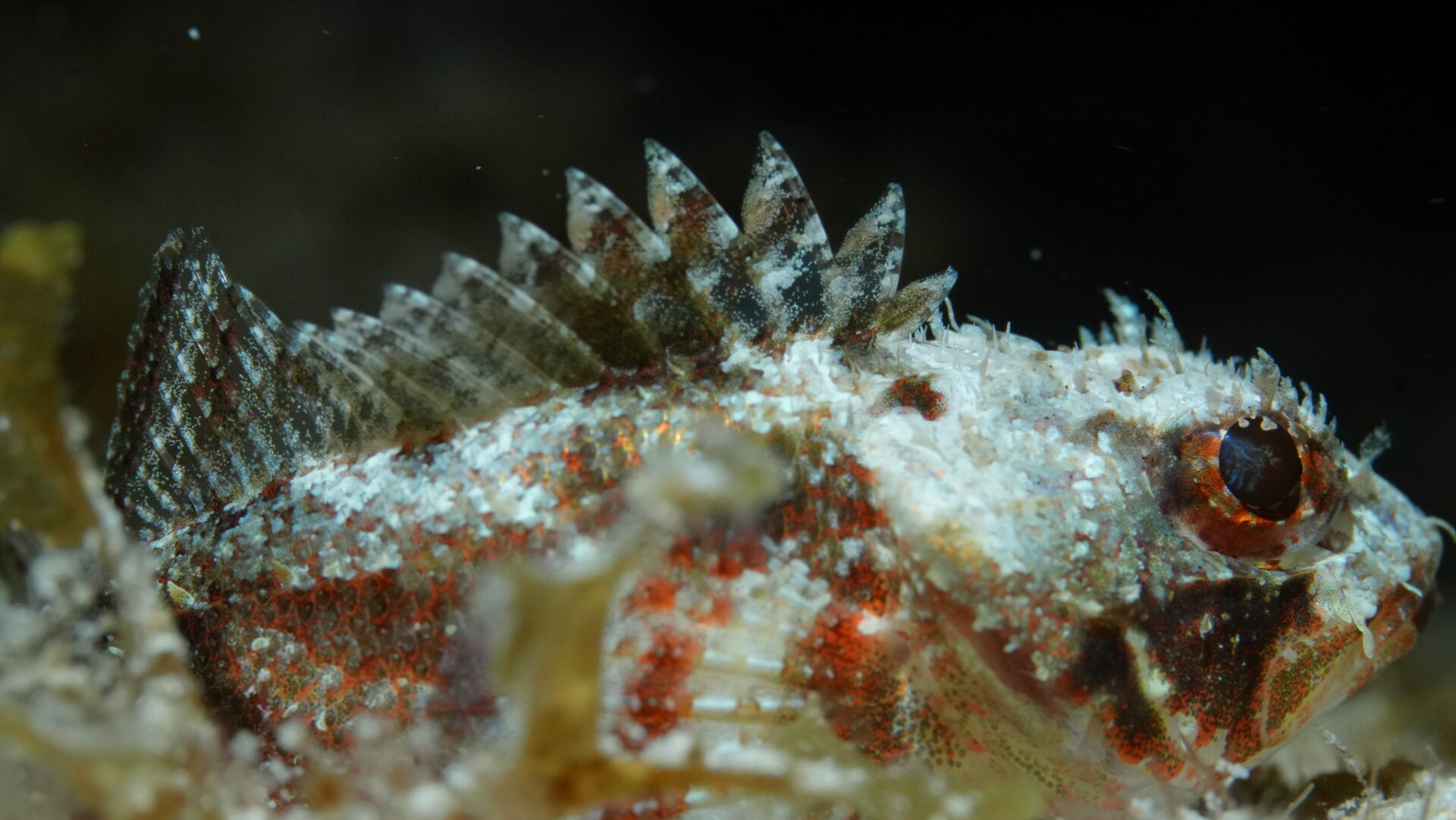
Individuals can grow to 11 cm, making this one of the smallest scorpionfish species. The head is very bony, with numerous spines; head length (length before dorsal fin) comprises 40-47% of standard length. Adults have almost no pit on top of head behind eyes, with narrow space between eyes and moderate eyes with small mushroom-shaped cirri on the upper quarter. The distinctive mushroom-shaped projections on the upper portion of the eye are the source of its common name.
The dorsal fin has XII spines and 7.5-8.5 soft rays; the anal fin has 3 spines and 5 rays; pectoral fins have 19-21 rays with some upper rays branched in adults. The bone over the front of mouth bears 2 spines pointing down, and the bone ridge under the eye has 3 spines. Coloration is mottled red, with the tail fin bearing 2 indistinct bars at the middle and end.
The species is marine and reef-associated, occurring at depths from 1 to 73 meters. It inhabits primarily offshore islands and is infrequently caught in continental waters. The fish is found in clear water over sand and turtle grass; it is less common around coral reefs. Most species from the Scorpaenidae family are found near or on the bottom and are known to lead solitary lives and only aggregate for reproduction.
The mushroom scorpionfish is a benthic resident that spends much of its time on the seafloor. Its small size and preference for shallow, clear waters over sandy substrates distinguish it from larger, deeper-dwelling scorpionfish species. The species shows site fidelity to its preferred habitats, particularly around offshore islands where it remains relatively common.
The species occurs in subtropical waters of the western Atlantic from Florida (USA), Bahamas, and Yucatan (Mexico) to Curaçao and probably northern South America. GBIF records document occurrences throughout this range, with particularly dense observation clusters in Florida coastal waters, the Caribbean islands including the Cayman Islands, Dominica, Guadeloupe, and Martinique, and Central American locations such as Honduras, Belize, and Panama. iNaturalist observations confirm active populations in these regions as of 2026.
The species exhibits a clear preference for reef-associated habitats at shallow to moderate depths. It avoids the deepest portions of its depth range and is rarely encountered in waters exceeding 50 meters. The concentration of observations around offshore islands and shallow coastal areas reflects its ecological specialization for these environments.
Little is documented specifically about the diet of Scorpaena inermis. However, its trophic level is 3.7 ±0.5, based on diet studies, indicating it is a secondary or tertiary consumer. Related Scorpaena species are known to feed primarily on crustaceans and small fishes. The trophic level suggests the mushroom scorpionfish occupies a position as a carnivorous predator in reef food webs, feeding on benthic invertebrates and small fish available in its shallow habitat.
As a small, bottom-dwelling predator, Scorpaena inermis likely employs an ambush feeding strategy typical of scorpionfish, remaining motionless on the seafloor before striking at passing prey. The species’ small mouth and size restrict it to consuming small prey items.
The species reproduces sexually. Most scorpionfish are oviparous, with planktonic larvae, and eggs are probably released in buoyant gelatinous mass. Little is documented about the specific reproductive cycle, maturity age, or fecundity of Scorpaena inermis.
Scorpaenidae species are known to aggregate only for reproduction, suggesting that mushroom scorpionfish remain solitary except during breeding periods. The planktonic larval stage allows for dispersal across the species’ wide geographic range, explaining its presence across multiple Caribbean islands and mainland coasts.
The mushroom scorpionfish is classified as Least Concern by conservation authorities, reflecting its stable status across its range. The species exhibits high resilience with a minimum population doubling time of less than 15 months, indicating rapid population recovery capacity if numbers decline. The species has low vulnerability to fishing, with a vulnerability score of 10 of 100.
No specific conservation threats have been documented for this species. Its small size, limited commercial value, and preference for offshore island habitats insulate it from most fishing pressure. The species’ broad geographic distribution across multiple countries and island systems further reduces extinction risk from localized disturbances.
The distinctive mushroom-shaped cirri (small finger-like projections) on the upper quarter of each eye give this species its common name and likely serve a sensory function.
At a maximum of 11 centimeters, the mushroom scorpionfish is one of the smallest members of the Scorpaenidae family, making it difficult to observe in the field.
The species inhabits waters from the surface (1 meter depth) down to 73 meters, showing remarkable depth tolerance for such a small fish.
iNaturalist observations document this species being actively recorded as recently as April 2026, with multiple sightings in Florida’s Phil Foster Park and Blue Heron Bridge, popular diving destinations.
The species’ trophic level of 3.7 places it as a secondary predator in reef food webs, feeding on small invertebrates and fish.
Despite its wide distribution across the Caribbean and western Atlantic, the mushroom scorpionfish remains infrequently caught and rarely encountered by humans, suggesting cryptic behavior and habitat preferences that limit observation opportunities.