
Fungi
Home »
Lucilia cuprina
| Kingdom | Animalia |
|---|---|
| Phylum | Arthropoda |
| Class | Insecta |
| Order | Diptera |
| Family | Calliphoridae |
| Genus | Lucilia |
| Species | Lucilia cuprina |
Key metrics will appear once data is available.
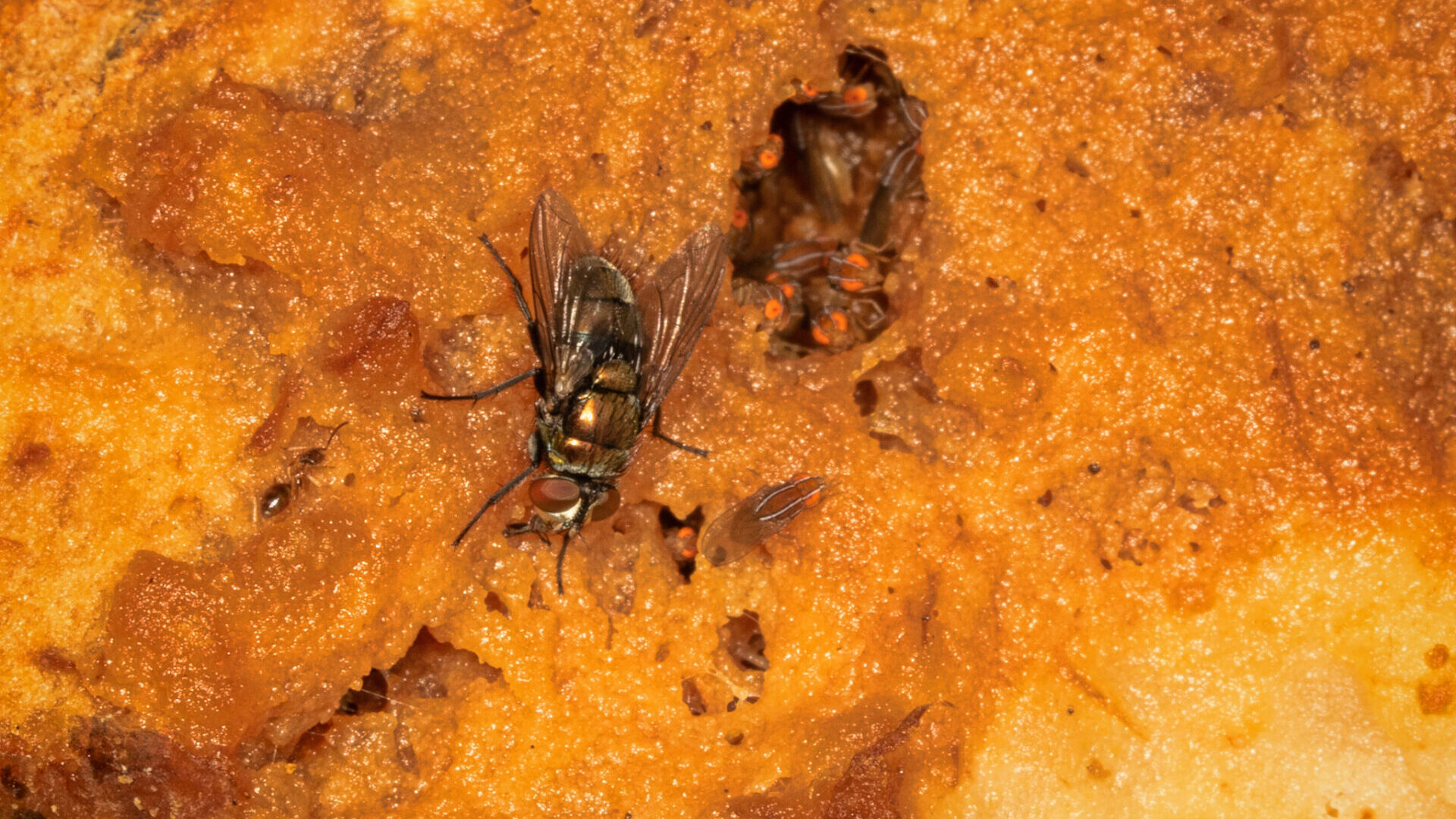
Lucilia cuprina is a metallic green blowfly and one of the world’s most significant agricultural pests. The species is characterized by a metallic outer appearance and reddish eyes, with a shiny green or greenish/blue abdomen with bronze/coppery reflections. Formerly named Phaenicia cuprina, this Australian sheep blowfly belongs to the family Calliphoridae. The fly causes the condition known as “fly strike” (myiasis), a parasitic infection of living tissue that affects sheep worldwide and has major economic consequences for pastoral industries.
L. cuprina can fly up to 10 miles (16 km) looking for food, and can be found on foods ranging from carrion to decaying fruit. The species is found across multiple continents, from Australia to North America, and has become increasingly problematic in regions where it was previously absent. These blow flies prefer warmer weather with soil temperatures above 15 °C, air temperatures above 17 °C and below 40 °C.
L. cuprina has a round to oval body shape with length varying from 4.5–10 mm. They have two pairs of wings, the first pair being membranous wings and the second pair being reduced wings known as halteres, which are used for flight stabilization. Adults are easy to distinguish due to bristles on the meron, in addition to the arista, the prominent hair on the terminal antennal segment being plumose, or feathery.
L. cuprina is most easily identified by its strong dorsal setae and black thoracic spiracle. It is almost indistinguishable from its conspecific L. sericata, and the difference between the two can be determined only by microscopic analysis of the occipital setae. Because of their metallic appearance, Lucilia species are known as the bronze bottle flies.
Larvae are often found in shaded regions of carrion, while the adults prefer bright, open areas. Adults of L. cuprina arrive early on carrion, appearing hours or even minutes after death. This rapid colonization makes the species valuable for forensic investigations. They prefer low wind conditions with wind speeds below 30 km/h.
It is well known because of its importance in forensic entomology. Since it is one of the first flies to occupy a corpse upon its death, its lifecycle stage can help determine time of death. Once it lands on a corpse, it lays its eggs, which hatch into larvae, followed by its pupal and finally the adult stages. Forensic professionals may then form a post mortem interval by the life stage found on the corpse.
GBIF records show that L. cuprina has been documented across at least 17 countries spanning multiple continents, including Australia, New Zealand, Brazil, Mexico, the United States, Israel, and parts of Asia. The species has established populations in diverse environments from urban areas to semi-arid regions and woodlands.
Although known as the Australian sheep blowfly, L. cuprina can be found in other parts of the world, including Africa and North America. L. cuprina, although it is a worldwide pest, is very climate specific – dryer climates. A forensic investigator may conclude that a corpse has been relocated from its original location if it is found in a moist climate with L. cuprina on it.
L. cuprina can be found on foods ranging from carrion to decaying fruit. Sheep blowflies cannot lay eggs until they have consumed a protein meal. They then mate and the female flies develop eggs. Depending on the size of the female, batches of up to 200 eggs can be laid per ovarian cycle.
The larvae are highly specialized feeders. The larvae of the Australian Sheep Blowfly normally feed on carcasses of dead animals but will also cause fly-strike in sheep. The female fly locates a sheep with ideal conditions, such as an open wound or a build-up of faeces or urine in the wool, in which she lays her eggs. The emerging larvae cause large lesions on the sheep, which may prove to be fatal.
The male is sexually mature at emergence. Females require a protein meal, from manure, carcasses, skin exudates (weeping skin) or existing flystrike before mating and seeking out, by smell, a place to lay their eggs. Lucilia can mature up to 300 eggs in each ovarian cycle and lay a new batch of eggs every 4–8 days.
On the fresh body, they lay their eggs. The eggs then hatch into larvae that begin to feed and grow. After about five days, larvae enter the pupal stage. The eggs hatch after 8–24 hours and the maggots immediately start feeding on the sheep, moulting twice during the 3–5 days before they drop off and burrow into the ground to pupate.
The whole process can take anywhere 11–21 days depending on environmental conditions, including temperature and food availability. In most cases, higher temperatures and a better plane of nutrition lead to a faster lifecycle. L. cuprina can have between four and eight generations per year depending mostly on temperature.
The Australian sheep blowfly is the major pest blowfly species in Australia. It is responsible for initiating over 90 per cent of all flystrike. Blowfly strike, or fly strike, is a serious welfare problem in the animal industry. This cutaneous myiasis or infestation not only causes severe discomfort or stress to the animal, but also causes death when left untreated.
Due to the difficulty in controlling these flies, considerable losses in the sheep industry occur every year. Also, concern is increasing for insecticide use and the surgical procedures done to control L. cuprina, making this not only an animal welfare issue, but also an economical one. Lucilia has adapted to this poor performance by becoming an obligate parasite of sheep, that is, it breeds almost exclusively on sheep, virtually free of competitors.
No formal conservation status has been assigned to this species, as it is considered a pest rather than a species of conservation concern. Management efforts focus on control and prevention rather than protection.
Adult Australian Sheep Blowflys lay maggots rather than eggs. This means their full life cycle can sometimes be completed within seven days.
The maggots of L. cuprina rapidly grow while eating the living flesh of the sheep, and secrete ammonia, thus poisoning the sheep.
The maggots of L. cuprina have been used by medical doctors for debridement therapy for patients who suffer from wounds that are healing slowly. The maggots cleanse the wound by eating the dead and infectious skin and preventing gangrene and further infection.
Ewe lambs and female sheep are primarily affected and are struck predominately in the rear quadrant of the animal due to fecal staining.
Putrefactive odours and odours associated with fleece rot bacteria or dermatophilosis are particularly attractive to female flies seeking out susceptible sheep.
Current research involving L. cuprina and other Lucilia species range from identifying genetic variation between the different species to the ultrastructure of flies’ eggs. Egg ultrastructure has recently become important in the field of forensic science. It is used to distinguish L. cuprina eggs from other Lucilia species, such as Lucilia illustris and Lucilia sericata. This defining feature becomes relevant when determining the post mortem interval because it varies with each species.
Sheep blowflies can live for over a month in the field.